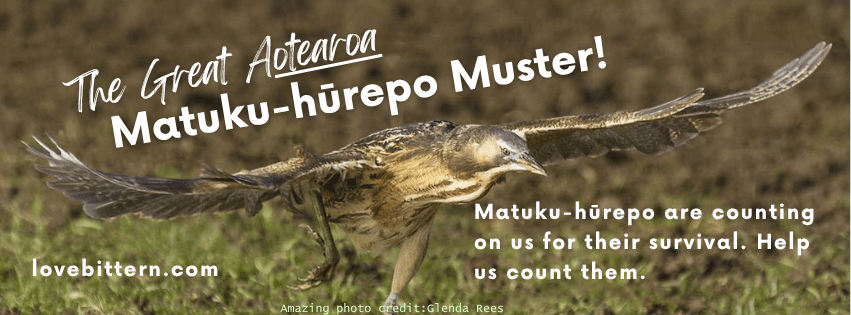
Matuku-hūrepo are a highly mobile species capable of traveling from region to region – which means that you could count one in your wetland one day and the same bittern could be counted again in another place the next day.
During the spring breeding season male bittern are more likely to stay in one place.
The Great Matuku-hūrepo Muster synchronises the counts right across the country so we don’t end up double counting bittern.
QUICK REFERENCES
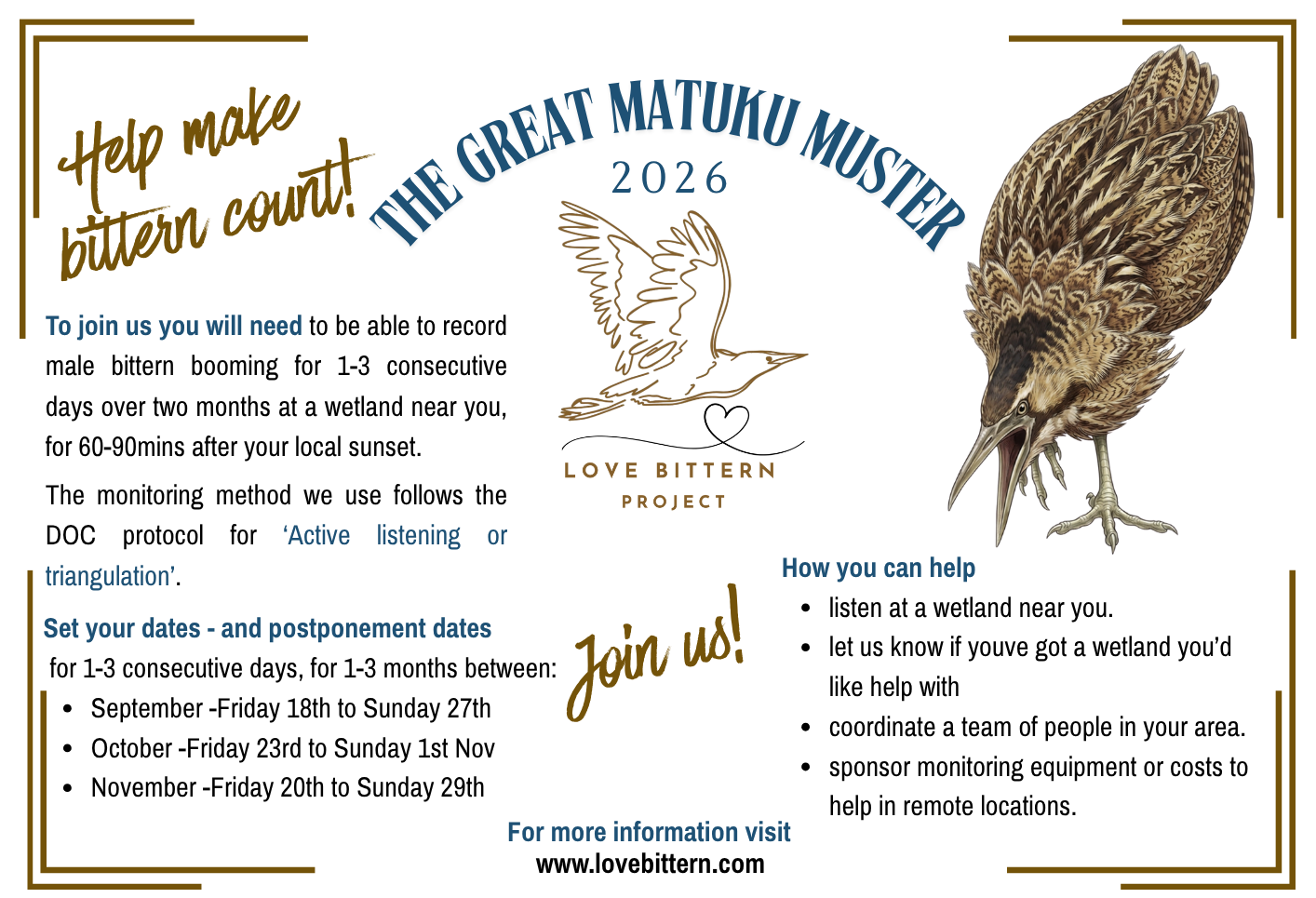
Dates (1-3 consecutive days, for 1-3 months) between:
- September -Friday 18th to Sunday 27th (full moon 27th)
- October -Friday 23rd to Sunday 1st Nov (full Moon 26th)
- November -Friday 20th to Sunday 29th (full moon 25th)
We recommend targeting the first weekend and using the following week, or weekend as your postponement dates.
Links
- Sign up for the muster here
- Learn how to take part here.
- Community Guide & Workbook here
- Manual forms here
- Record a summary of your results here.
Need help? Contact Wendy 022 526 1972 or email lovebittern@gmail.com
The population of Bittern here in Aotearoa is unknown – somewhere between 600-1000 birds are left we think… and they are on the brink of extinction.
You can play an important role in helping us to count Bittern booming at a wetland near you during their breeding season.
During the spring breeding season male bittern are more likely to stay in one place. They also give themselves away by booming in a series of foghorn like ‘whoom…whoom’ sounds that can be heard over 1km away. This booming tells us they are trying to hold territory, they are warning other males to stay away and attracting females.
By booming consistently in the same wetland, day in day out – it tells us he’s sure he has good habitat and/or a female there too!
This is the best time to monitor and still our best way to estimate the population of bittern (females are much harder to detect).
To join us you will need to be able to count the males booming for 1-3 days each month at a wetland near you, on the weekend closest to the full moon in Sept/Oct in the North Island or Oct/Nov in the South Island, (or all 3 months) for 60-90mins after your local sunset.
The monitoring method we use is ‘Active listening or triangulation’. To learn how to carry our active listening click here.
Last year’s results were marred by the weather. So this year we are providing groups the opportunity to set their own dates for 3 consecutive days monitoring as well as their postponement dates within the following 10 day windows:
- September Friday 18th to Sunday 27th (full moon 27th)
- October Friday 23rd to Sunday 1st Nov (full Moon 26th)
- November Friday 20th to Sunday 29th (full moon 25th)
Connect with other people in your district and region to synchronise your dates as much as possible.
nb. because of the longer twilights we recommend 90 minutes in Otago and Southland.
Sign up for the 2026 Great Matuku-hūrepo Muster here.
You can record your results using the manual matuku muster field sheet or you can use The Conservation Hub app. To learn more click here to go to our active listening monitoring page.
Send your results, the number of people who helped, the number of sites you listened at and the number of individual male bittern you heard using this form.(coming soon)

