Using acoustic recorders to determine absence or presence.
Passive Acoustic monitoring
One of the most efficient ways to detect bittern is through passive acoustic monitoring.
This involves placing autonomous recorders around the wetland, set to record when the male bittern is most likely to be heard during peak booming.
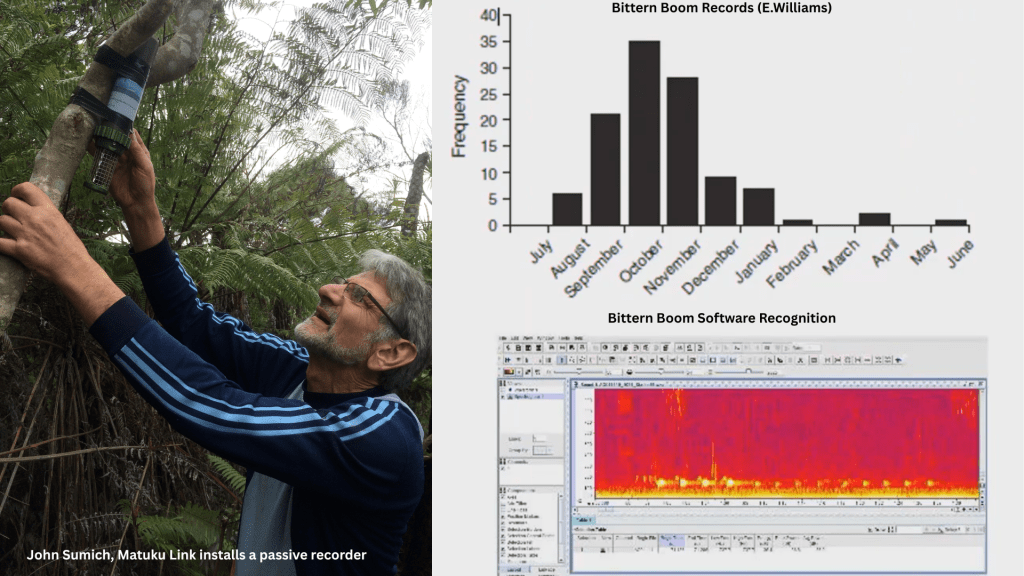
This peak booming occurs during the Spring (see graph in image above), pre-sunrise or post-sunset.
We reccomend following the DOC Monitoring Protocol here.
For the current suit of autonomous recorders (eg. DOC AR4, Alto AR5, Audiomoths etc) the sound is stored locally in the device on a memory card, which is collected, then manually checked using software that can detect and/or show the sound in a spectrogram for both visual (see image above) and aural confirmation.
Here is access to a FREE tutorial on how to detect a Bittern in your sound records utilising FREE!
If you dont have the skills or the time …and have budget, we offer independent services to help you plan, analyse and report on your acoustic monitoring.
 LOVE BITTERN PROJECT