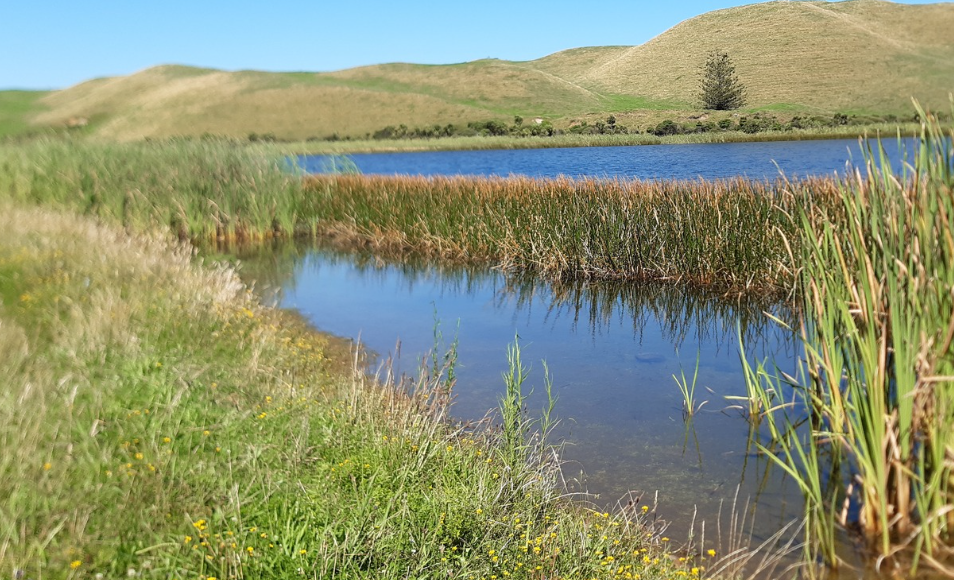
Bringing back Bittern: Does your Wetland pass the water test?
Water is the life source—but for the Matuku-hūrepo (Australasian Bittern) who are one step from extinction here in Aotearoa New Zealand, it’s also a high-stakes hunting ground.
As a visual hunter, bittern rely on clear, shallow water to be able to catch their prey. If the water is murky or too deep, they go hungry.
They also need deeper, more permanent, stable water with emergent vegetation to help protect them while nesting and resting.
To bring these cryptic creatures back, we have to start by looking at what our water is telling us in our wetlands and do what we can to help.
Do you have what it takes to host a bittern? Our ‘Habitat for Hūrepo’ assessment starts by checking the water…
Is your wetland wet enough?
This seems like an obvious question, however a lot of wetlands are large shallow areas and they don’t stay wet enough, for long enough, for water loving species to function.
There is an army of aquatic and semi-aquatic species in the shape of plants, microbes, invertebrates, and insects working together in their underwater world to help keep our water clean and clear…and if there is not enough water they struggle to win the battle
For matuku-hūrepo your wetland needs to be wet enough to provide hunting grounds and a deep water sanctuary for at least 90 days from spring into the summer.
Check – does your wetland stay wet enough for 90 days from spring into the summer to to provide:
- Hunting grounds: Clear, shallow water (wading depth 15-25cm) with an abundance of fish and low-stature plants for cover?
- A sanctuary: Deeper permanent water (more than 50cm) with stable water levels and tall reeds or rushes growing out of the water for resting and nesting?
Take Action: Find out what you could do to help keep your wetland wet for longer. Can you redirect more water or use bunds and weirs to help hold water?(contact your regional council for help and find out what you can do with and without a permit)
Is the water accessible?
Bittern need to be able to access clear shallow water to hunt. Some plants like watercress, willow weed or monkey musk can form dense carpets over the water limiting access and degrading the water quality.
However it’s all about balance, these same plants are helping to filter the water, provide cover for eels and fish, are an indicator for excess nutrients and could provide a foraging platform for bittern to feed off.
- The cress test: are water loving plants like water cress overabundant and covering the water almost entirely?
Take action: Can you change the nutrient load? reduce the plant’s coverage? plant a wider band of filter plants(reeds and rushes) to stop nutrients before they hit the water? and/or plant taller plants like harakeke (flax) to shade out sun lovers?
Is your water clear enough?
If you can’t see 25cm into the water, Matuku-hūrepo won’t be able to see fish and eels to catch them. Murky water could also be an indicator of sediment, algae or pollutants which are unattractive to most fish species.
- The wiggle test: Stick your arm in the water up to your elbow with your palm flat.. Wiggle your fingers. Can you see them? If yes, a bittern can see a fish. If not, your water is too turbid.
Take Action: Does your wetland have a deep pool as a sediment trap? Does it have enough plants like reeds, rushes and sedges that help trap sediment and fix bacteria to take up excess nutrients?
Why it Matters
When we fix the water for the Matuku-hūrepo, we aren’t just saving bittern. We are restoring a complex ecosystem that supports everything from tiny aquatic insects to the most dominant apex predator of all—us. Wetlands help keep our water drinkable, fishable and swimmable.
 LOVE BITTERN PROJECT