Observation recorded led to wetland…and Bittern.
Here is another example of how an observation recorded, led to an opportunity to connect with landowners, to support the work they (and others) have already done in restoring the Pungapunga wetland for Bittern.
This district is a real gem, close to the Waikato awa and other hotspots for Bittern we are involved with.
This is a copy of the report the landowners have got with their ‘next steps’, you might be able to apply these to your wetland or connect with us to discuss where you are at and we can help you with yours!
Pungapunga Wetland, Bittern Monitoring Report (copy of pdf)
OBJECTIVE
To confirm the presence/absence of bittern in Pungapunga Wetland, using observations and results to engage with landowners and other stakeholders around ‘next steps’ to continue to support the good work already done in helping to create a better future for Bittern in Pukekawa.
SUMMARY
Bittern Monitoring was carried out at Pungapunga Wetland following a Bittern recorded on lovebittern.com on 8th September 2025 at a nearby location. Pungapunga Wetland was referenced as a likely breeding territory nearby and contact made with landowners (who were one party in a larger project recently completed (2024?) with Waikato River Care Inc and others) who had helped to restore part of the wetland on their farm.
An automatic or acoustic recording device, known as a ‘ARD’, was provided by Waikato Regional Council and deployed by the landowners at the edge of the wetland, which recorded from 5th October to 12th November (almost 6 weeks) at dawn and dusk.
Sound analysis revealed a single Bittern. The Bittern was most clearly heard around 18th October just after 5am, when he boomed 5 times in a sequence, with 12 sequences in a 15 minute period. This pattern tells us it’s a strong male.
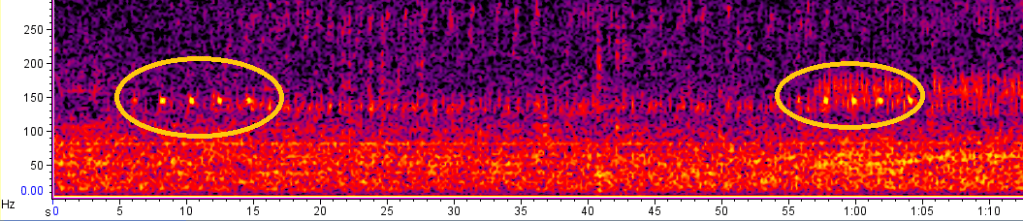
Listening conditions were difficult and only periodic booming could be detected either side of this during October, while no booming was detected in November.
No other monitoring was done on adjacent land or in the wider district. More extensive monitoring and further community engagement would help to connect all of the projects in the area across Pukekawa district and raise awareness for Bittern and their wetland homes.
YOUR NEXT STEPS
Habitat Assessment. A simple assessment of ‘Habitat for Hūrepo’. In its most simplest form this can be carried out by answering these 7 simple questions in relation to your wetland:
- Is the wetland wet enough for long enough? to provide 15-25cm of clear water for foraging and water that remains deep enough for emergent vegetation (reeds, rushes etc coming out of permanent water) to be sustained for 90 days from Spring?
- Is there an abundance of food for Bittern? small eels, fish and/or frogs?
- Is the food accessible? Does the wetland have complex edges with a gentle sloping profile into the water for foraging? Is it connected by waterways that provide safe passage for fish (and juvenile Bittern)?
- Does the wetland have vast areas of low stature vegetation with little or no trees? Large open areas of reeds, rushes, grasses or sedges?
- Are pests stopped before they arrive at the wetland? Is there feral cat and mustelid monitoring and control in place? Are invasive weeds surveyed and strategically removed?
- Is there little or no human disturbance? Consider the impacts of recreational activities, and on a wider landscape scale infrastructure that might alter wetlands or safe aerial passage (windfarms, solar farms, roading(drainage))
- What impacts will there be as a result of climate change? Will the wetland be wetter, drier, more prone to floods or fire..more saline? Is there a back up …another wetland in the catchment that can help mitigate impacts for Bittern?
Boom Monitoring. Ideally more extensive monitoring should be carried out following DOC protocol for Active Listening or Triangulation and/or Acoustic Monitoring using multiple recording devices placed 500m apart around the wetland complex. This provides a-
- population index – the total number of individual males in the wetland complex
- population estimate – for every male it is assumed there is one female, sub-adult or non-vocal male, so the number of males is doubled to give us the population estimate
- Indication of where there may be breeding territories
- Indication of when peak booming occurs, which in turn is an indication of when breeding may be starting to occur
Detecting females and juveniles. Females are only present ~50% of the time where a male is found booming. Where possible wetlands should be monitored early in Spring for female breeding and or nesting behaviour. If females are detected, foraging lanes should be monitored from late spring through the summer using game cameras to detect females and juveniles.
 LOVE BITTERN PROJECT